ElectriCities Appoints New Executive Team Members

New Chief Operating Officer and Chief Strategy Officer bring decades of expertise, vision

RALEIGH, N.C. (MARCH 27, 2023) — ElectriCities of North Carolina, Inc., the membership organization that provides power supply and related critical services to over 90 community-owned electric systems in North Carolina, South Carolina, and Virginia, has named two new members to its executive team.

Kathy Moyer is the organization’s new Chief Operating Officer, and Andy Fusco is its Chief Strategy Officer.

As Chief Operating Officer, Kathy Moyer will oversee all of ElectriCities’ power supply and distribution operations.

Moyer has over 28 years of experience in electric utility operations. She joined ElectriCities in 2000 as an Operations Engineer and moved into the role of Manager, NCMPA1 Operations in 2011. In 2013, Moyer assumed the role of Electric Systems Manager for ElectriCities operations in Huntersville and Cornelius, North Carolina, and then later, for operations in Pineville, North Carolina. In 2016, she accepted her most recent role of Vice President, Operations.

As Chief Strategy Officer, a new position, Andy Fusco will oversee ElectriCities’ newly titled Strategy & Services Division, formerly known as Member Services. He will be accountable for strategic planning and implementing value-added member services.

Fusco has over 29 years of experience, 22 of which are in the electric industry. He joined ElectriCities in 2001 as Supervisor, Resource Planning. He was promoted to Manager, Resource Planning in 2003, Engineering & Construction Manager in 2008, and Director, Planning in 2012. In 2013, he took on his most recent position of Vice President, Member Services & Corporate Planning.

The recent organizational updates align with ElectriCities’ strategic planning efforts and follow the February announcement that Matt Schull would be stepping down as ElectriCities COO to join Missouri River Energy Services as its president and CEO.

“We’re committed to ensuring that ElectriCities is well positioned to meet our members’ needs now and in the future,” said ElectriCities CEO Roy Jones. “I’m confident that Kathy’s and Andy’s expertise and vision will enable us to continue to move public power forward.”

Media contact
Elizabeth Kadick
VP, Communications, ElectriCities
(919) 760-6285
ekadick@electricities.org

ElectriCities Joins Nation in Celebrating the Value of Public Power

RALEIGH, N.C. (September 28, 2022) — ElectriCities of North Carolina, Inc., a nonprofit organization that provides support and services to public power communities in North Carolina and beyond, joins more than 70 public power communities in North Carolina and more than 2,000 across the country in celebrating Public Power Week, Oct. 2-8, 2022.

Public power communities are cities and towns that own and operate their electric systems. Public Power Week is an annual opportunity to shine a light on the value those municipally owned utilities provide their customers and their communities.

“Public power is a crucial component in cities and towns across North Carolina,” said Roy Jones, CEO of ElectriCities. “Public power providers drive overall community health by delivering unmatched electric reliability, affordable and sustainable power, excellent local service, and essential jobs in these communities.”

Unmatched reliability

Public power is known for providing its customers with exceptional reliability. In fact, North Carolina public power providers deliver safe, affordable, and sustainable electricity with a reliability rating of 99.98%—more reliable than other power providers in the state.

North Carolina’s public power customers experience 40% fewer outages than other power providers’ customers. And when the power does go out, public power lineworkers restore power faster than other providers do.

The American Public Power Association (APPA), a national trade association, has recognized 26 public power communities in North Carolina as Reliable Public Power Providers for providing outstanding reliability, safety, workforce development, and system improvement—more utilities than in any other state.

Locally powered for local good

Because public power providers are locally owned, locally operated, and locally controlled, they answer to their local customers—not to shareholders, and they make decisions based on what’s best for their customers and their communities. Public power utilities also provide essential jobs that support their local economy.

In public power communities, the utility’s employees—the lineworkers, customer service representatives, engineers, and other specialists—are local municipal employees. As members of the community, they are dedicated to keeping the lights on for their neighbors.

Since public power providers are not-for-profit, any funds generated by residents paying their power bills go back into the community.

“The strength of public power is the value it provides its customers and communities,” said Jones. “Public power providers are essential community assets and dependable institutions that provide excellent service, valuable energy solutions, and a commitment to community.”

Strong support system

North Carolina public power communities are part of a mutual aid network that spans the state and country, providing invaluable support during hurricanes and other natural disasters while maintaining a superior safety record.

“That network of public power communities provides a broad support system,” Jones said. “It enables public power providers to share knowledge and access resources that help leverage growth opportunities, locate needed equipment, and ensure the superior service public power is known for. It also provides a unified voice on state and federal issues affecting public power.”

Rich history and bright future in North Carolina

Many of North Carolina’s public power cities and towns have been providing electricity to their communities for more than 100 years. Along the way, they’ve adapted to changes in technology, how power is generated, the demand for electricity, and more to keep public power communities strong.

Jones said technological advances, the demand for clean energy, and evolving customer expectations continue to drive change in the energy industry—and will for years to come.

“Being community-owned puts public power providers in a good position to take advantage of the opportunities for innovation that come with industry growth and evolution,” he said. “They get to decide how to invest in and power their future based on what’s best for their communities and their customers.”

“The future is bright for these public power providers and their customers who benefit every day from a better quality of life,” Jones said. “For all the value it provides, I’m thrilled to celebrate public power during Public Power Week and every day of the year.”

Learn more about the value of public power at www.electricities.com/benefits.

Media contact
Elizabeth Kadick
Manager, Communications, ElectriCities
(919) 760-6285
ekadick@electricities.org

ElectriCities Celebrates Electric Lineworkers’ Value, Commitment, and Service

RALEIGH, N.C. (April 8, 2022) — ElectriCities of North Carolina, Inc., along with public power providers across the state and the country, is honoring and celebrating electric lineworkers this month.

Monday, April 11, is North Carolina Lineworker Appreciation Day, and Monday, April 18, is National Lineworker Appreciation Day. Both days were designated to recognize lineworkers and their contributions to protect public safety, keeping electricity flowing to homes and businesses.

“Day or night, rain or shine, lineworkers rise to the occasion and put the needs of their neighbors and community above their own,” said Roy Jones, CEO of ElectriCities. “They perform difficult work that requires a high level of skill and expertise, and they often do that work in grueling and dangerous conditions for long hours—all while adhering to strict safety protocols.”

In North Carolina, public power lineworkers keep the lights on for nearly 1.3 million people in the more than 70 cities and towns across the state that own and operate their electric system. Nationwide, public power lineworkers support 2,000 cities and towns—more than 49 million people.

Public power lineworkers often live in the cities and towns they serve, maintaining their locally owned and operated electric systems and quickly responding when storms or other disasters damage lines or equipment. These neighbors serving neighbors are key to the exceptional reliability public power providers are known for.

According to data reported to the U.S. Energy Information Administration, the average public power customer nationwide is without power for less than half the amount of time customers of other types of utilities are. North Carolina’s public power customers fare even better. They experience 40% fewer outages than other power providers’ customers in the state. And when the power does go out, the outage lasts, on average, only about one-third the time of those other providers.

Along with keeping their own communities powered, public power lineworkers are part of a mutual aid network that spans the state and the country and enables public power crews to go where help is needed in the wake of disasters that damage electric systems.

“Lineworkers from our member communities never hesitate to answer the call and go where help is needed,” said Gregg Welch, Manager of Programs & Services at ElectriCities and a coordinator of the organization’s Emergency Assistance Program. “That may mean working a few hours or days to help a nearby municipality repair storm damage or, most recently, working a few weeks to help rebuild a hurricane-ravaged system in Houma, Louisiana, or to help build a system that lights up a Navajo reservation for the first time.”

“There’s no doubt, lineworkers power our lives,” said Jones. “Their service to their communities and, when it’s needed, to communities across the state and the country is the backbone of public power. I’m proud to celebrate these hometown heroes, today and every day.”

#####

18 North Carolina Public Power Communities Recognized for Excellence

RALEIGH, N.C. (March 29, 2022) — ElectriCities of North Carolina, Inc., has presented 18 North Carolina communities with Public Power Awards of Excellence. The awards align with ElectriCities’ five strategic priorities, recognizing exceptional performance in:

  • Communicating the value of public power
  • Continuous improvement
  • Grid modernization
  • Wholesale power cost
  • Workforce planning and development

“The commitment and dedication North Carolina’s public power providers demonstrate to their communities is always impressive,” said ElectriCities CEO Roy Jones. “I’m proud of these award winners for continuing to find ways to deliver better service and more value to the communities they serve while meeting the challenges of the past few years head-on.”

This year’s award winners span the state, from Morganton to Greenville, and represent some of the state’s smallest and largest public power communities.

The 2021 Public Power Awards of Excellence and the winners of each are:

The VALUE OF PUBLIC POWER AWARD highlights communities that communicate the value of municipal electric system ownership to key stakeholders. This year’s winners are:

  • Dallas
  • Fayetteville Public Works Commission (PWC)
  • Granite Falls
  • Greenville Utilities Commission
  • Kinston
  • Lexington
  • Maiden
  • New River Light & Power
  • Rocky Mount
  • Statesville
  • Wilson

The CONTINUOUS IMPROVEMENT AWARD recognizes cities and towns that constantly review and enhance all aspects of public power while focusing on cost reduction and increased efficiencies in current and future operations. This year’s winners are:

  • Apex
  • Fayetteville PWC
  • Granite Falls
  • Greenville Utilities Commission
  • Kinston
  • Maiden
  • Morganton
  • New River Light & Power
  • Rocky Mount
  • Statesville
  • Wilson

The GRID MODERNIZATION AWARD focuses on promoting investment in public power communities’ electric distribution systems and in technology to ensure safety and reliability and to exceed customer expectations. This year’s winners are:

  • Clayton
  • Fayetteville PWC
  • Greenville Utilities Commission
  • Laurinburg
  • Morganton
  • New River Light & Power
  • Statesville
  • Wilson

The WHOLESALE POWER COST AWARD recognizes communities that provide competitive and stable wholesale electric rates that meet the power supply need of Power Agency members. This year’s winners are:

  • Fayetteville PWC
  • Gastonia
  • Granite Falls
  • Greenville Utilities Commission
  • Kinston
  • Lexington
  • New River Light & Power
  • Rocky Mount
  • Statesville
  • Tarboro
  • Wilson

The WORKFORCE PLANNING AND DEVELOPMENT AWARD honors communities that promote a workforce plan to attract, develop, and retain the necessary talent to provide safe, reliable power and to lead public power forward. This year’s winners are:

  • Albemarle
  • Dallas
  • Fayetteville PWC
  • Gastonia
  • Granite Falls
  • Greenville Utilities Commission
  • Kinston
  • Lexington
  • Maiden
  • New River Light & Power
  • Rocky Mount
  • Statesville
  • Tarboro
  • Wilson

Nearly 1.3 million people in more than 70 cities and towns across North Carolina get their electricity from public power providers. Since these public power communities own their electric system, they maintain local control and decision making over their operations, providing unbeaten reliability, local jobs, and support for their local economy.

###

ElectriCities Awarded for Communications Excellence by the American Public Power Association

RALEIGH, N.C. (November 4, 2021) — ElectriCities has been recognized by the American Public Power Association (APPA) for its communications efforts, earning an Award of Excellence in the print/digital category for its 2020 Annual Report.

ElectriCities is one of only 38 public power electric utilities and utility organizations that earned Excellence in Public Power Communications Awards from APPA this year. The national awards were presented during APPA’s Customer Connections Conference in Scottsdale, Arizona, and recognize public power organizations demonstrating outstanding work in three categories: print/digital, web/social media, and video.

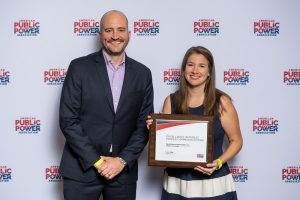
Lori Patterson, Brand + Creative Design Strategist at ElectriCities, receives Award of Excellence from Tobias Sellier, Senior Director, Media Relations & Communications at APPA

The ElectriCities Annual Report, shared with members and their communities, is a way for public power communities to connect over shared projects and learn from one another. The 2020 report celebrates five member utilities’ efforts to align with ElectriCities’ five strategic priorities: communicating the value of public power, workforce development, continuous improvement, grid modernization, and wholesale power cost. They did so while facing an above-average hurricane season in the midst of a pandemic.

“As communicators, our job is to showcase the value of public power across all communication channels,” said Elizabeth Kadick, Manager of Communications at ElectriCities. “These stories of commitment to excellence despite unprecedented challenges show that public power providers continue to rise to the occasion and raise the bar for themselves to continue to provide the reliable service their customers expect. We’re proud to share these stories and thrilled to be recognized on a national level for the important work we do on behalf of our member communities.”

In 2020, ElectriCities won an Award of Merit in the web/social media category for its Outage Communication Resources webpage and an Award of Excellence in the video category for its “How I Got Into Energy” feature.


About the American Public Power Association
The American Public Power Association (APPA) is the voice of not-for-profit, community-owned utilities that power 2,000 towns and cities nationwide. APPA represents public power before the federal government to protect the interests of the more than 49 million people that public power utilities serve, and the 96,000 people they employ. The association advocates and advises on electricity policy, technology, trends, training, and operations. Learn more at www.publicpower.org.

###

Southeast Electric Providers Receive Approval from FERC for New Energy Market Platform

SEEM PLATFORM TO BE OPERATIONAL IN 2022

RALEIGH, N.C. (October 14, 2021) — The Southeast Energy Exchange Market (SEEM) members today received clearance from the Federal Energy Regulatory Commission (FERC) for their proposed trading platform as a result of a 2-2 commission vote. By statutory law, tie votes on items are approved.

SEEM is a unique and thoroughly new approach to improving electricity competition. The new SEEM platform will facilitate sub-hourly, bilateral trading, allowing participants to buy and sell power close to the time the energy is consumed, utilizing available unreserved transmission.

SEEM is a 21st century solution designed for the incredible pace of change resulting from the electricity sector growing toward an ever-greener future.  Southeastern electricity customers will see cost, reliability and environmental benefits.

SEEM is a simple but powerful structure that follows all FERC-approved rules and requirements for existing bilateral markets today, but with additional data transparency. The FERC approval means SEEM can move forward building a technology platform to deliver on its goals and mission by mid-2022.

“We are excited the SEEM platform has received this approval. SEEM members want to thank the FERC commissioners and we also thank the FERC staff for their thorough review,” said Noel Black, Southern Company’s vice president of governmental affairs.

“SEEM will allow resources to more easily access the electricity wholesale market and will enable and encourage new technologies and approaches necessary to deliver more economic and clean energy to our customers. We look forward to soon delivering those benefits to customers,” Black said.

An independent third-party consultant estimated that total benefits to SEEM grid operators and customers range from $40 million to $50 million annually in the near-term, to $100 million to $150 million annually in later years as more solar and other variable energy resources are added.

Wind and solar resources are expanding rapidly in the Southeast. The SEEM marketplace will take advantage of renewable resources in the region leading to a cleaner, greener, more robust electricity system. As designed, SEEM also will have little bureaucracy and related expenses.

FERC’s approval document will be posted on the SEEM website at www.southeastenergymarket.com.

Founding members of SEEM are expected to include Associated Electric Cooperative, Dalton Utilities, Dominion Energy South Carolina, Duke Energy Carolinas, Duke Energy Progress, Georgia System Operations Corporation, Georgia Transmission Corporation, LG&E and KU Energy, MEAG Power, N.C. Municipal Power Agency No. 1, NCEMC, Oglethorpe Power Corp., PowerSouth, Santee Cooper, Southern Company and TVA. Some of these utilities will now make firm decisions about whether to commit as a result of the FERC approval. Participation in SEEM is open to other entities that meet the appropriate requirements.

The founding members represent nearly 20 entities in parts of 11 states with more than 160,000 MWs (summer capacity; winter capacity is nearly 180,000 MWs) across two time zones. These companies serve the energy needs of more than 32 million retail customers (roughly more than 50 million people).

Media Contacts:

Todd Terrell, Southern Company (404) 506-5333

Joe Wilkinson, Associated Electric Cooperative (417) 371-5253

Drew Elliot, ElectriCities of North Carolina (919) 260-2717

####

ElectriCities of NC Wins IEDC Awards in 2021

ELECTRICITIES OF NC RECEIVES EXCELLENCE IN ECONOMIC DEVELOPMENT AWARDS FROM THE INTERNATIONAL ECONOMIC DEVELOPMENT COUNCIL

RALEIGH, N.C. (OCTOBER 11, 2021) — ElectriCities of North Carolina, Inc., received multiple awards from the International Economic Development Council (IEDC) for its work advancing economic development programs and partnerships in public power communities. The honors were presented Oct. 5 at the IEDC Annual Conference in Nashville, Tennessee.

ElectriCities was awarded a Silver Rank for its LinkedIn advertising campaigns, a project in IEDC’s Paid Advertising Campaign category. The LinkedIn ads were part of a comprehensive campaign to convey the benefits of locating a business in North Carolina’s public power communities. They ran in 2020, rotating quarterly, and resulted in impressive engagement, qualified leads, and increased brand recognition.

In the Print Brochure category, ElectriCities won a Bronze Rank for its Economic Value Studies. ElectriCities’ Economic Value Studies are reader-friendly reports packed with hard data that shows how a municipally owned utility benefits its community, providing information such as how much revenue the utility generates, how reliable the electric system is, and the financial benefit of that reliability.

ElectriCities was also awarded a Bronze Rank for its Weekly Wire e-newsletter in the Digital Media category. Subscribers to the weekly newsletter include ElectriCities member community staff and stakeholders, as well as national and international site selectors and economic developers. Multiple economic development-themed issues throughout the year promote available grants, programs, and services that help ElectriCities member communities with economic development ventures.

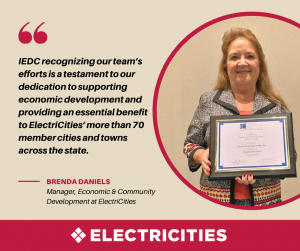
“It’s such a joy to enlighten businesses from around the world about the value of locating in a North Carolina public power community,” said Brenda Daniels, Manager of Economic & Community Development at ElectriCities. “IEDC recognizing our team’s efforts is a testament to our dedication to supporting economic development and providing an essential benefit to ElectriCities’ more than 70 member cities and towns across the state.”

IEDC’s Excellence in Economic Development Awards recognize the world’s best economic development programs, partnerships, and marketing materials, and the year’s most influential leaders. Awards in 25 categories honor organizations and individuals for their efforts in creating positive change in urban, suburban, and rural communities. IEDC received over 500 submissions from four countries. Following a nomination process held earlier this year, a diverse panel of economic and community developers from around the world judged the awards.

“The winners of IEDC’s Excellence in Economic Development awards represent the best of economic development and exemplify the leadership that our profession strives for every day,” said 2021 IEDC Board Chair and Invest Buffalo Niagara President and CEO Tom Kucharski. “We’re honored to recognize the more than 100 communities whose marketing submissions, projects, and partnerships have improved regional quality of life.”

About the International Economic Development Council

The IEDC is a nonprofit, nonpartisan membership organization serving economic developers. With more than 5,000 members, IEDC is the largest organization of its kind. Economic developers promote economic well-being and quality of life for their communities by creating, retaining, and expanding jobs that facilitate growth, enhance wealth, and provide a stable tax base. From public to private, rural to urban, and local to international, IEDC’s members engage in the full range of economic development experiences. Given the breadth of economic development work, our members are employed in various settings, including local, state, provincial, and federal governments, public-private partnerships, chambers of commerce, universities, and a variety of other institutions. When we succeed, our members create high-quality jobs, develop vibrant communities, and improve the quality of life in their regions. Learn more at iedconline.org.

# # #

ElectriCities Celebrates Public Power Week 2021

North Carolina ranks among nation’s top states for public power.

RALEIGH, NORTH CAROLINA [October 8, 2021]—Public power communities own their electric systems. Their local electric service providers deliver safe, reliable, and affordable electricity to power their homes and businesses. North Carolina benefits from being one of the nation’s leaders in public power, with the ninth largest number of public power utilities serving the ninth largest number of customers, according to data from the American Public Power Association. ElectriCities, a not-for-profit organization that provides support and services to public power communities in North Carolina and beyond, is celebrating those communities during Public Power Week, October 3-9, 2021.

“Public power provides our communities enormous value, measurable in local economic benefit and growth opportunities and seen in improved quality of life and peace of mind. Public power isn’t accountable to distant shareholders; it’s a shared asset owned by our neighbors and our communities,” said Roy Jones, CEO of ElectriCities.

Those benefits reach deep. The hallmarks of public power are increased reliability, affordability, and opportunities for local economic development. Unlike investor-owned utilities or electric cooperatives, public power utilities are community-owned, not-for-profit systems that are notable for providing local control, exceptional reliability, and outstanding customer service. The theme of this year’s Public Power Week, “Dedicated to Service / The Power to Deliver” celebrates those advantages.

“Public power in North Carolina has made communities stronger for more than 100 years,” Jones said. “We want to honor the service and commitment of our utility employees who dedicate themselves to keeping our neighbors and families connected. Public Power Week is a wonderful opportunity to celebrate the power of community.”

North Carolina currently has 72 public power providers, including four of the nation’s 100 largest public power utilities. Fayetteville Public Works Commission ranks as the 37th largest public power utility with more than 81,000 customers. Greenville Utilities Commission (#45), City of High Point (#77), and Wilson Energy (#94) are also among the nation’s largest public power utilities.

Reliability: A Public Power Tradition

Public power communities in North Carolina enjoy 33% fewer outages and 62% less time without power compared to investor-owned utilities in the state.

Reliability is about more than just convenience. When factory downtime equals real dollars lost and jobs are on the line, communities value their power provided by a utility that keeps the power on 99.8% of the time and restores power three times faster than investor-owned utilities or cooperatives.

North Carolina has 27 communities—more than any other state—recognized by the American Public Power Association as Reliable Public Power Providers. This special “RP3” designation certifies that utilities provide outstanding reliability, safety, workforce development, and system improvement.

Public power has a rich tradition in North Carolina that dates to 1889, when the City of Statesville first began using electric lights instead of gas streetlamps to illuminate the tiny downtown area.

Quick Facts about Public Power

  • North Carolina has 72 public power communities that collectively serve nearly 1.3 million people.
  • One in seven electricity customers in the U.S. are served by public power.
  • North Carolina is home to four of the nation’s 100 largest public power utilities.
  • Statesville was North Carolina’s first public power community. It began operating electric lights in 1889.
  • Nationally, there are more than 2,000 public power providers that collectively serve 49 million people.
  • Ten percent of the electricity generated in the United States comes from public power facilities.

# # #

ElectriCities CEO Roy Jones Testifies on National Panel Focused on Ensuring Reliability of the Electric Grid

Local public power leader lays out challenges and priorities to ensure a reliable electric grid in the future.

RALEIGH, NORTH CAROLINA [September 30, 2021]—Roy Jones, CEO of ElectriCities of North Carolina, testified today as part of a national panel of experts convened by the Federal Energy Regulatory Commission to discuss challenges to the reliability of the nation’s electric grid. Jones, testifying as one of nine experts invited by FERC to the virtual Reliability Technical Conference, spoke on behalf of public power communities nationwide, including the 89 community-owned electric systems in North Carolina, South Carolina, and Virginia that are members of ElectriCities.

Jones addressed challenges facing the nation’s bulk electric grid, focusing on supply chain concerns, the industry’s evolving resource mix and its impact on resource adequacy, and the need for greater coordination between industry and government partners to promote reliability and circulate information regarding threats to the grid.

“Keeping the lights on during a dramatic change in the nation’s resource mix may be the single most important challenge of the mid-21st century for utility managers and state and federal regulators,” Jones said.

The challenge, he said, is attributable to the rapid shift away from centralized generation to non-synchronous resources, including renewables, battery storage, and other technologies. As this shift accelerates, industry and regulators must keep a close eye on resource adequacy and coordinate on flexible ramping and load-following resources, along with energy-assured generation. Jones stressed that while public power utilities continue to reduce their greenhouse gas emissions, FERC must work concurrently to monitor and maintain grid reliability.

Jones serves as vice chairman of the member representatives committee of the North American Electric Reliability Corporation, the not-for-profit entity created in 1968 to reduce risks to the reliability and security of the continental electric grid. Jones also spoke on behalf of the Large Public Power Council, the Transmission Access Policy Study Group, and the American Public Power Association. APPA represents more than 2,000 public power systems that provide more than 15 percent of all retail electric sales and serve more than 49 million people.

Pertaining to supply chain, Jones said FERC must assist industry in pressing for additional government assistance to influence supplier cybersecurity practices.

“Vendors must take on supply chain security as a fundamental responsibility,” he said, urging electric industry and federal governmental partners to bring vendors to the table to find consensus on addressing the issues.

Read Jones’ full prepared testimony here; find more information about the technical conference here.


About the Large Public Power Council

LPPC is an association of the 26 largest state-owned and municipal utilities in the nation and represents the larger, asset-owning members of the public power sector. LPPC members are also members of APPA and own approximately 90% of the transmission assets owned by non-federal public power entities.


About the Transmission Access Policy Study Group

TAPS is an association of transmission-dependent utilities located in 35 states. It is an effective voice in the fight for open and equal transmission access and for strong protections against the exercise of market power in electric markets. TAPS supports vigorously competitive wholesale electric markets and a robust grid.


About the American Public Power Association

APPA is the national service organization representing the interests of not-for-profit, state, municipal and other locally owned electric utilities in the United States. More than 2,000 public power systems provide over 15% of all kilowatt-hours sales to ultimate customers and serve over 49 million people, doing business in every state except Hawaii.

# # #

ElectriCities-supported Bill to Provide N.C. Municipal Power Agency Number 1 Investment Flexibility Passes General Assembly

Authority could mean lower wholesale rates for 19 cities in central and western North Carolina

RALEIGH, NORTH CAROLINA [June 23, 2021]—  On Tuesday, the North Carolina General Assembly unanimously passed Senate Bill 323, a bill that would give the 19 cities and towns that comprise N.C. Municipal Power Agency Number 1 (NCMPA1) the authority to invest NCMPA1’s nuclear decommissioning fund through a combined fund managed by North Carolina State Treasurer Dale Folwell. The result could mean a decrease in wholesale electric rates for NCMPA1, which is a co-owner of the Catawba Nuclear Power Station in York County, S.C.

“Today is a great day for the 19 cities and towns that participate in N.C. Municipal Power Agency Number 1,” said Roy Jones, CEO of ElectriCities, the membership organization of municipally owned electric utilities that includes the 19 NCMPA1 municipalities. “I want to thank House Speaker Tim Moore and Senate Leader Phil Berger, along with our bill sponsors, for making this legislation a priority and for their continued support of public power communities.”

As with all nuclear station owners, the Nuclear Regulatory Commission requires the establishment and maintenance of a decommissioning fund to restore a site once a nuclear plant is closed. Similar to a pension fund, funds must be accumulated through member contributions and investment earnings to meet projected costs. The contributions are ultimately paid for by NCMPA1 member ratepayers.

The bill could lead to lower wholesale electric rates, assuming current assumptions of revenue, cost, and projected and actual market returns hold true. It would allow the power agency to invest the decommissioning fund in the existing Ancillary Governmental Participant Investment Program (AGPIP) managed by the state treasurer. The expanded range of investment options available through AGPIP would provide NCMPA1 the opportunity to earn higher returns in the fund.

“We appreciate the support and guidance of Treasurer Folwell during this process,” Jones said. “Mr. Folwell has long been a friend to public power communities in North Carolina, and we thank him for his continued support.”

The 19 member cities of NCMPA1 are Albemarle, Bostic, Cherryville, Cornelius, Drexel, Gastonia, Granite Falls, High Point, Huntersville, Landis, Lexington, Lincolnton, Maiden, Monroe, Morganton, Newton, Pineville, Shelby, and Statesville.

# # #